I sometimes use affiliate links in content. This doesn’t cost you anything but I may make a commission payment from anything you buy through these links. As an Amazon Associate I earn from qualifying purchases. All opinions remain my own.
There’s a reason sandalwood shows up in more meditation cushions, temples and perfume counters than almost any other scent on earth. It’s warm, woody and quietly grounding in a way that’s hard to describe until you’ve smelled it. It’s also one of the most faked essential oils on the market, which makes knowing what you’re actually buying just as important as knowing what to do with it once you have it.
Table of Contents
🌳 What Sandalwood Essential Oil Actually Is
Sandalwood essential oil is steam-distilled from the heartwood and roots of sandalwood trees, most commonly Santalum album (Indian or Mysore sandalwood) or Santalum spicatum (Australian sandalwood). The trees need to reach a certain maturity, often decades, before the heartwood develops the concentration of aromatic compounds that give sandalwood its scent, which is part of why the oil is so expensive to produce.
Santalum album is generally considered the gold standard, prized for its high alpha-santalol content and rich, creamy aroma. Santalum spicatum has a slightly drier, sharper profile and a lower price point, and it’s often what you’ll find in more affordable “sandalwood” products. Neither is fake, they’re simply different species with different chemistry, so it’s worth checking the botanical name on the label rather than assuming all sandalwood oil is interchangeable.
🔍 Why “Sandalwood” Is One of the Most Faked Oils Around
This is the single most important thing to understand before you buy. Sandalwood is one of the most commonly adulterated essential oils sold, and it isn’t close. Independent testing of commercial sandalwood oils has repeatedly found samples that don’t meet the recognised international standard for genuine sandalwood, with synthetic substitutes like sandalore, javanol and polysantol turning up in bottles labelled “100% natural.”
Part of the problem is price. Genuine Mysore sandalwood oil wholesales for somewhere in the region of $1,500 to $3,000 per kilogram, which works out to roughly $1.50 to $3 per millilitre before it even reaches a retailer. If you’re seeing “pure sandalwood essential oil” priced dramatically below that, it’s worth asking what’s actually in the bottle.
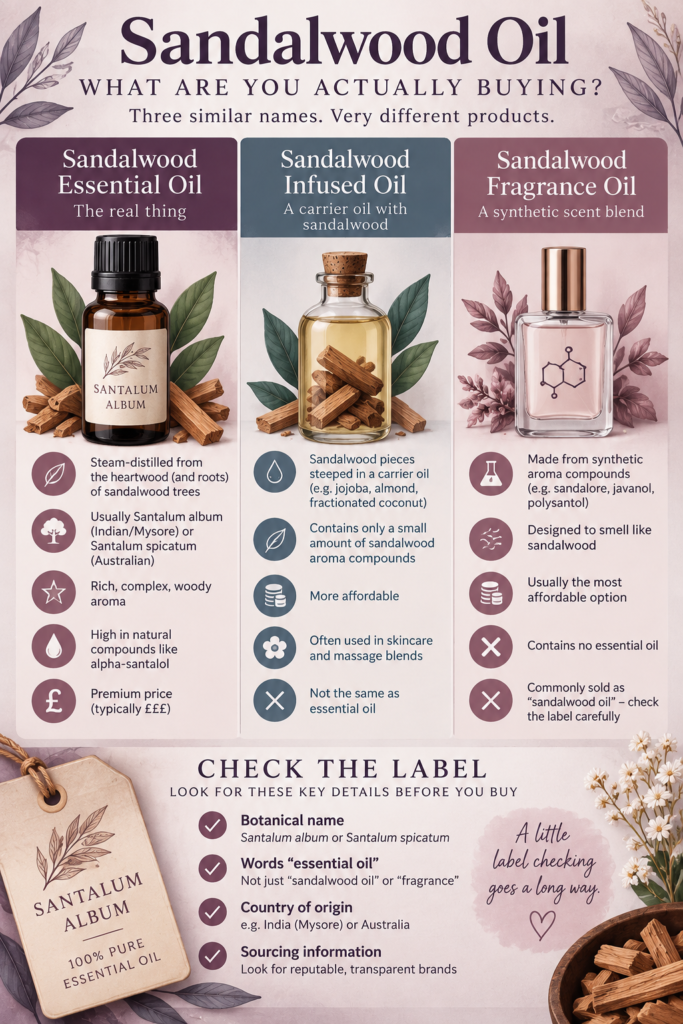
It’s also worth being clear on a separate distinction: a genuine sandalwood essential oil is different from a sandalwood-infused oil (a carrier oil that’s simply had sandalwood steeped in it) or a sandalwood fragrance oil (a synthetic scent blend with no essential oil in it at all). All three get sold under similar-sounding names, but only the true essential oil carries the aromatic compounds people are actually looking for. Check the label for the Latin species name and “essential oil,” not just “sandalwood oil” or “sandalwood fragrance.”
🧘 Traditional Uses: Grounding, Meditation and Atmosphere
Sandalwood has a long history in meditation and spiritual practice, largely because of its calm, grounding scent profile. In a home aromatherapy context, it’s most commonly reached for to support a peaceful, focused atmosphere during meditation, yoga or quiet wind-down time in the evening.
It’s also a popular choice in skin-focused blends, where its smooth, woody base note pairs well with floral or citrus top notes. As a base note, sandalwood tends to linger longer than lighter oils, which is part of why perfumers and aromatherapists alike reach for it to anchor a blend rather than lead it.
None of this is medical territory, sandalwood isn’t a treatment for anything, but as a mood-setting, atmosphere-shaping scent it’s one of the most reliably loved oils in aromatherapy. Many people find it pairs naturally with a wind-down routine, whether that’s a few drops in the diffuser during an evening stretch or worked into a simple self-massage oil after a bath.
⚠️ Safety: Dilution, Skin Sensitivity, Pregnancy and Pets
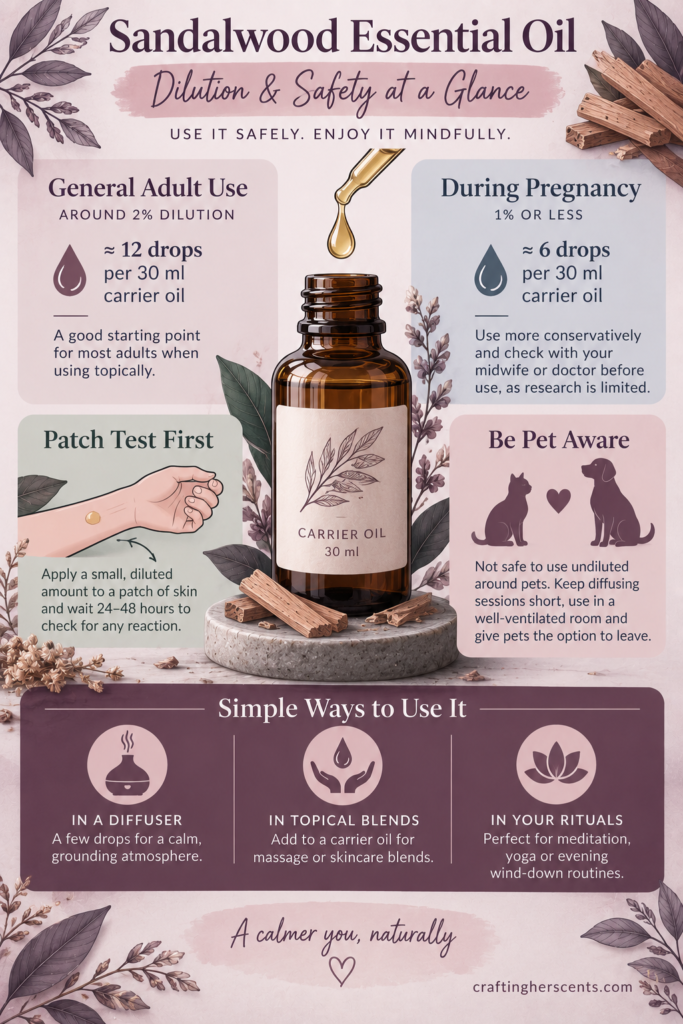
Sandalwood is generally considered non-irritating for most people, but it can still cause a reaction in those with sensitive skin, and anyone applying it topically regularly, not just occasionally, has a somewhat higher risk of developing sensitisation over time. A patch test on a small area of skin before regular use is a sensible precaution.
For general topical use, a dilution of around 2% (roughly 12 drops of essential oil per 30ml of carrier oil) is a reasonable starting point for adults. If you’re pregnant, dilute more conservatively, around 1% or less, and check with your midwife or doctor before introducing any new essential oil into your routine, since research on essential oil safety in pregnancy is limited.
Sandalwood, like most essential oils, isn’t safe to diffuse continuously or apply undiluted around cats, dogs or other household pets. Cats in particular process essential oil compounds poorly, so if you share your home with one, keep diffusing sessions short and confined to a room they can leave. If you diffuse it at home, do so in a well-ventilated room and give pets the option to leave, rather than assuming a “natural” scent is automatically pet-safe.
💧 How to Use It: Diffuser Blends and Topical Application
For diffusing, sandalwood pairs beautifully with other warm, grounding notes. A simple evening blend is 3 drops sandalwood, 2 drops lavender and 1 drop bergamot, run through your essential oil diffuser for 30 to 60 minutes before bed. For a more meditative blend, try 3 drops sandalwood with 2 drops frankincense, a pairing that leans into both oils’ grounding reputation.
For topical use, dilute sandalwood in a carrier oil like jojoba or sweet almond oil before applying to skin. Amber glass roller bottles are a practical way to premix and carry a diluted blend, since the amber glass protects the oil from light degradation and the roller tip keeps application mess-free.
🌍 Sourcing and Sustainability: Why Genuine Sandalwood Costs What It Does
Santalum album has faced decades of over-harvesting and illegal logging, particularly in India, to the point that wild populations are now considered threatened and the species is subject to CITES trade restrictions, meaning legitimate international trade requires proper permits and documentation. This isn’t a reason to avoid sandalwood altogether, but it is a reason to buy from suppliers who can speak clearly about where their oil comes from.
Sustainably managed plantations, particularly large-scale replanting programmes established in Australia, have started to create a more traceable, renewable supply of Santalum album, alongside the naturally more available Santalum spicatum. Look for suppliers who mention plantation-grown or certified sourcing rather than staying vague about origin, since that’s usually a sign they can actually back up their sourcing claims.
When you’re comparing sandalwood products, a supplier who can tell you the species, the country of origin and how it was harvested is generally a better sign than one who simply says “pure sandalwood” with no further detail. A noticeably low price, a vague label, or a scent that seems thin and one-dimensional rather than rich and layered are all worth treating as red flags. Given both the sustainability pressures and the counterfeiting problem covered above, sandalwood is genuinely one of the essential oils worth spending a little more time researching before you buy, rather than grabbing the cheapest bottle on the shelf.