I sometimes use affiliate links in content. This doesn’t cost you anything but I may make a commission payment from anything you buy through these links. As an Amazon Associate I earn from qualifying purchases. All opinions remain my own.
Buying for someone who loves candles, diffusers and anything that makes a room smell good is one of the easier gift jobs on the list. It is also one of the easier ones to get wrong. A pretty box can hold a genuine essential oil, a synthetic fragrance oil or a bottle of “infused” oil, and the label does not always make the difference obvious.
This guide is organised by type of gift rather than by brand, so you can start with the person and work towards the present. Before the gift ideas, there is a short section on what to check before you buy, because it saves more disappointment than any shortlist could.
Table of Contents
🔍 What to Check Before You Buy
A few seconds with the label tells you most of what you need to know. It is worth doing for every bottle, even from shops you trust.
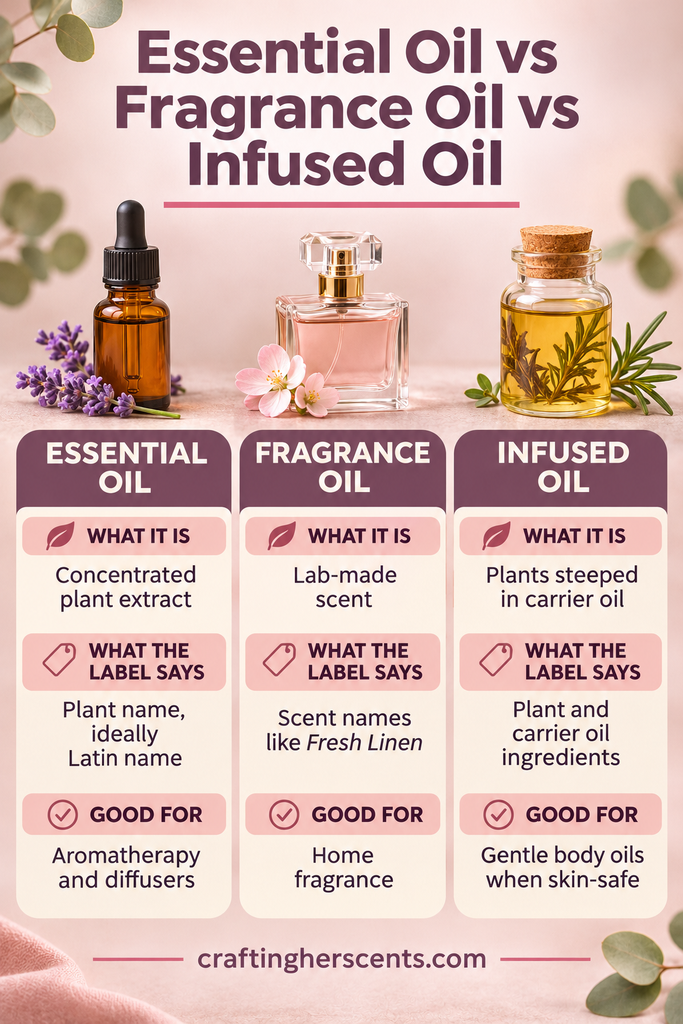
Essential oil, fragrance oil and infused oil are three different things. They are often shelved side by side and sometimes named in almost identical ways.
- Essential oil: a concentrated aromatic extract taken from a plant, usually by steam distillation or cold pressing. The label should name the plant, ideally with its Latin name, such as Lavandula angustifolia.
- Fragrance oil: a lab-made scent designed to smell like something, such as “Fresh Linen” or “Winter Berry”. It can smell lovely, but it is not aromatherapy.
- Infused oil: a plant steeped in a carrier oil, like olive or sunflower. It is gentle and useful, but it is not an essential oil, and it will not scent a room the way a diffuser oil does.
If you want a deeper grounding in the first of those, our essential oils for beginners guide walks through what they are and how they are made.
Look for a plant name, not just a scent name. “Lavender” or “Lavandula angustifolia” is a good sign. “Lavender Dreams” or “Calming Blend Fragrance” is not.
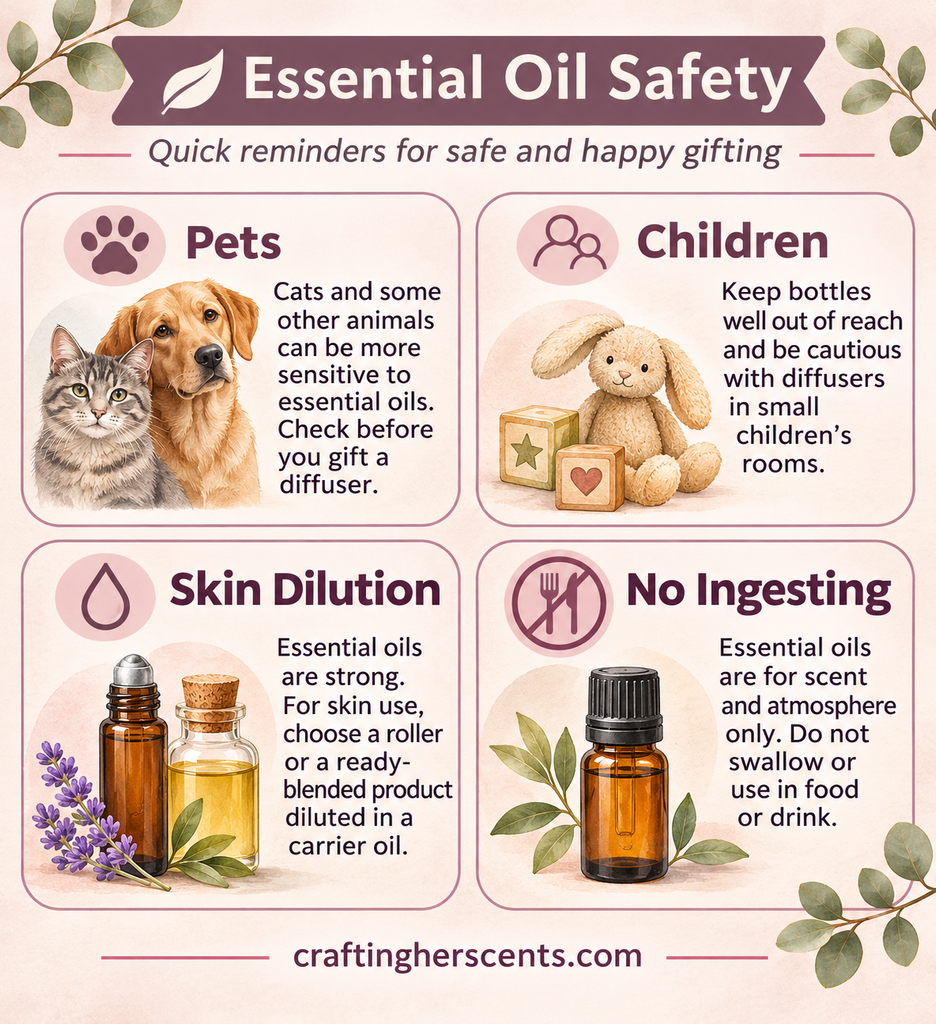
Be wary of anything sold as medicinal. Reputable aromatherapy gifts are sold for scent and atmosphere. If a set promises to treat things or is marketed to be swallowed, leave it on the shelf. Essential oils are not for eating or drinking, and a gift set that suggests otherwise is a red flag.
Check the size and the bottle. Genuine essential oils usually come in small, dark glass bottles with a dropper or orifice reducer. A large, clear plastic bottle of a very cheap “oil” is more likely to be fragrance oil.
Our guide to what to look for when buying essential oils goes into more detail if you want to compare a few brands side by side.
🐾 Safety Notes for the Person You Are Buying For
A gift is only a good gift if it is safe in the recipient’s home. Two minutes of thought here is worth it.
- Pets: cats and some other animals are more sensitive to essential oils than people are. If the recipient has a cat, a dog, a bird or small animals, a diffuser may not be the best choice. Our essential oils and pets guide covers the basics.
- Young children: keep bottles well out of reach, and be cautious with diffusers in small children’s rooms.
- Skin: essential oils are strong. Anything applied to skin needs to be properly diluted in a carrier oil, which is why a roller or a ready-blended product is often a safer present than a loose bottle. Our carrier oils guide explains the basics.
- Sensitivities and scent preferences: some people simply dislike strong scents, or find them uncomfortable. If you are not sure, go for something mild or easy to turn off.
If you are ever unsure about a particular person, a gift that is easy to use lightly, like a wearable or a candle, is usually safer than a gift that fills a whole room.
🎁 Gift Ideas by Type
Diffusers
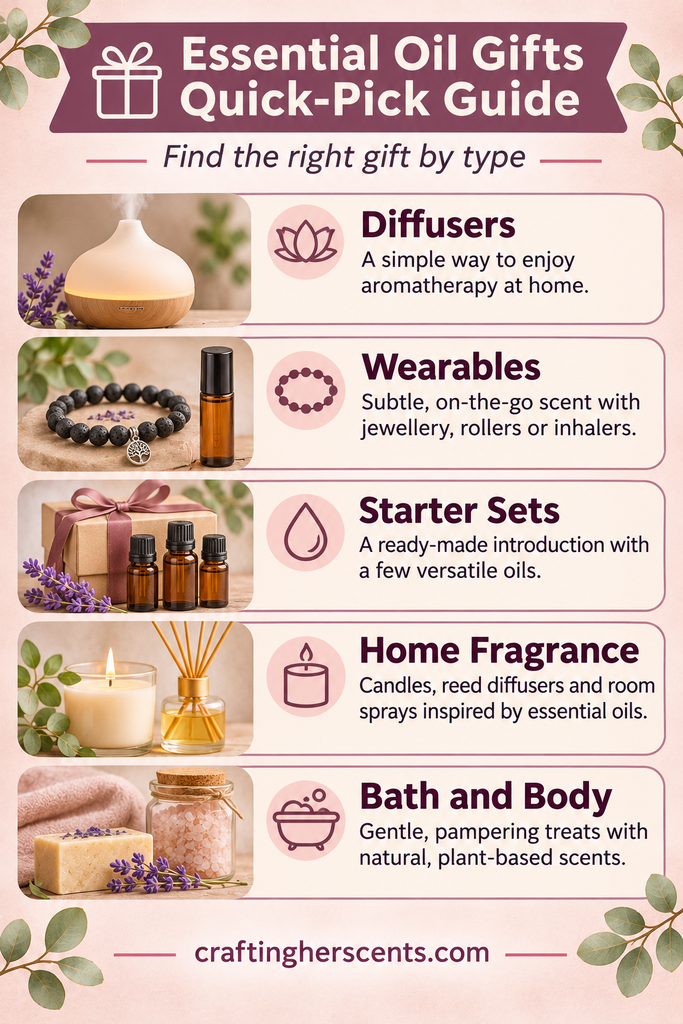
A diffuser is the classic aromatherapy gift, and it is one of the few that works for almost every kind of recipient. The trick is matching the type to the person.
- Ultrasonic diffusers: the most common type. They use water and a small amount of oil, and many have a timer or a soft light. A simple ultrasonic model is an easy first diffuser for most people. If you are shopping for this category, an ultrasonic essential oil diffuser in a size to suit a bedroom or living room is a safe place to begin.
- Smart diffusers: app-controlled and good for people who like to set routines. Our guide to smart diffusers explains who they suit.
- Matching the room: a diffuser that is too small or too big for the space is a common disappointment. Our guide to choosing the right diffuser for your space is worth a skim before you buy.
A diffuser on its own is a fine gift. A diffuser with one or two good oils is better, and it saves the recipient an extra trip to the shop.
Wearable and Rollerball Options
These are good for people who like a little scent on the move: a commuter, a student, someone who travels a lot.
- Diffuser jewellery: a pendant or bracelet that holds a drop or two of oil. A lava bead diffuser bracelet is a simple, low-key option, and the beads can be refreshed with whichever oil the wearer prefers.
- Rollerballs: a small bottle with a roller top, already diluted in a carrier oil. Look for products that clearly state the dilution and the ingredients.
- Inhalers: a small tube that keeps the scent close without scenting the whole room.
Our wearable diffusers guide covers rollerballs, jewellery and travel options in more detail.
Starter Sets and Single Oils
A starter set is the obvious choice for someone who is curious about aromatherapy but has not bought anything yet. The risk is a set that is padded with fragrance oils or oddly named blends.
- Good signs: clear plant names on every bottle, small dark glass bottles, and a reasonable number of oils rather than a dozen tiny ones.
- Crowd-pleasing choices: lavender, sweet orange and a woody or evergreen oil tend to suit a wide range of tastes. A bottle of sweet orange essential oil is a cheerful, easy single-oil gift.
- Something more complete: a labelled essential oil starter set with a few popular singles gives the recipient room to experiment.
If you would like something a little more personal, pair one or two oils with a short handwritten note about how you like to use them. It costs nothing and makes the gift feel chosen.
Home Fragrance: Candles, Wax Warmers and Simmer Pots
Not every aromatherapy fan wants a diffuser. Some people prefer something that feels cosy and familiar.
- Candles: look for ones scented with essential oils rather than fragrance oils if that matters to the recipient. The label will usually say. If it does not say, it is probably a fragrance oil.
- Wax warmers: a flameless way to scent a room. Our guide to what wax warmers are and how to use them explains how they work, and our comparison of diffusers and candles can help you decide which suits the person better.
- Simmer pot kits: a jar of dried fruit, spices and botanicals to simmer on the hob. They are festive, inexpensive and need no equipment.
Home fragrance is a good choice for anyone who wants a scented home without learning anything new.
Bath and Body
Bath and body gifts feel indulgent, and they suit people who like a ritual at the end of the day.
- Bath salts and soaks: look for a short ingredient list with plant names.
- Body oils and massage bars: these should be clearly diluted and made for skin. Do not buy a bottle of undiluted essential oil as a body product.
- Lip balms and hand creams: small, useful and easy to tuck into a stocking.
These are also easy to match to a budget, which brings us to the next section.
💷 Budget Tiers
You do not need to spend a lot to give something thoughtful. Think in tiers and pick the one that suits the relationship and your own limits.
- Stocking fillers: a single essential oil, a lip balm, a small candle or a bracelet. These are small, useful and easy to wrap.
- Mid-range: a basic diffuser, a labelled starter set, a bath and body set or a good wax warmer. This is the sweet spot for most gifts.
- Splurge: a smart diffuser, a larger collection of single oils in good packaging or a combined set of diffuser, oils and a candle. These suit someone who is already enthusiastic.
If you are unsure of the recipient’s tastes, a mid-range gift with a gift receipt is usually safer than a splurge.
Another option is a subscription. They look generous, but they are not right for everyone, and it is worth knowing the maths before you commit. Our post on whether essential oil subscription boxes are worth it explains who benefits and who ends up with a drawer of unused bottles.
🚫 What Not to Buy
A few things are best avoided, however nice the packaging looks.
- Ingestible or “medicinal” sets: anything that suggests swallowing essential oils, adding them to drinks or using them to treat conditions.
- Cheap fragrance-oil sets sold as aromatherapy: if the bottles say “fragrance oil” or the set has a long list of dessert scents, it is a scented-home gift, not an aromatherapy one. It might still be a nice present, but it should not be described as aromatherapy.
- Large bottles of undiluted oil for use on skin: these are easy to misuse. Choose pre-diluted products for anything that goes on skin.
- Anything with no ingredient list: if you cannot tell what is in the bottle, the recipient cannot either.
- Strong scents for someone you do not know well: a bold, heavy fragrance can be a lot for someone who prefers a gentler home.
✂️ If You Would Rather Make It
If you enjoy a project, a handmade gift can be just as thoughtful as a bought one. Our easy homemade bath gifts with essential oils is a good place to start, and it works well alongside a bought item such as a diffuser or a candle.
🎄 A Quick Gift-Buying Checklist
Before you check out, run through this list.
- Does the label name the plant, not just a scent?
- Is it clearly an essential oil, not a fragrance oil or infused oil?
- Is there any medicinal or ingestible claim? If so, leave it.
- Does the recipient have pets, small children or scent sensitivities?
- Is anything for skin already diluted?
- Is the size and type right for how they will use it?
If you can say yes to the first two and no to the third, you are in good shape.
💜 Final Thoughts
The best aromatherapy gifts are simple, clearly labelled and chosen with the recipient’s home in mind. A small, well-chosen present beats a big set of mystery bottles every time.
If you are still deciding, start with the person: their space, their routine and who lives with them. Then pick the type of gift that fits, check the label and wrap it up. That is really all there is to it.