I sometimes use affiliate links in content. This doesn’t cost you anything but I may make a commission payment from anything you buy through these links. As an Amazon Associate I earn from qualifying purchases. All opinions remain my own.
If you have spent any time searching “how to make lavender essential oil,” you have probably noticed the internet splits into two unhelpful camps. One tells you it is as easy as tossing lavender in a jar of oil and waiting a fortnight. The other skips straight to steam distillation equipment without explaining why that route is such a different project. Neither gives you the full picture, so let me lay it out properly.
There are two genuinely different things you can make at home, and they are not interchangeable, even though the internet treats them that way constantly.
Table of Contents
🌿 True Essential Oil vs Infused Oil: What You Are Actually Making
A true lavender essential oil is produced through steam distillation. Steam passes through plant material, carries the volatile aromatic compounds with it, and is then condensed and separated from the water. It is a genuinely low-yield process. You need a proper still (or a stovetop distillation rig), a large volume of fresh lavender, and realistic expectations: it can take a substantial amount of plant material to produce even a small amount of true oil. This is an advanced, equipment-heavy project, not a weekend craft.
A lavender-infused oil is a different product entirely. You are steeping lavender flowers in a carrier oil (think olive, sweet almond, or jojoba) to draw out the aromatic and beneficial compounds into that oil. It is not essential oil, and it should never be labelled or sold as such. What it is: a genuinely lovely, fragrant, usable oil that most home crafters can make reliably with basic kitchen equipment.
I am going to walk you through the infused oil method in full, because it is the realistic, high-quality option for making something at home. I will also cover the basics of home steam distillation further down, for anyone curious about that more advanced route.

⚠️ Safety & Side Effects
Before anything else, a few safety points worth reading properly, not skimming.
Infused oil is far gentler than true essential oil because the aromatic compounds are far less concentrated. Even so, treat it with respect:
Always patch test before wider use. Apply a small amount to your inner forearm and wait 24 hours to check for irritation or sensitisation, particularly if you have sensitive skin.
Keep any lavender oil, infused or true essential oil, well away from pets. Cats in particular can react badly to essential oils and concentrated plant compounds, so store your finished oil somewhere they cannot reach it.
Keep out of reach of children, and away from eyes and broken skin.
If you are pregnant, nursing, or managing a health condition, check with your doctor before using lavender oil regularly, even in infused form.
This is a fragrance and skincare ingredient project, not a medical treatment. Avoid ingesting either version of this oil.
🧴 What You Will Need
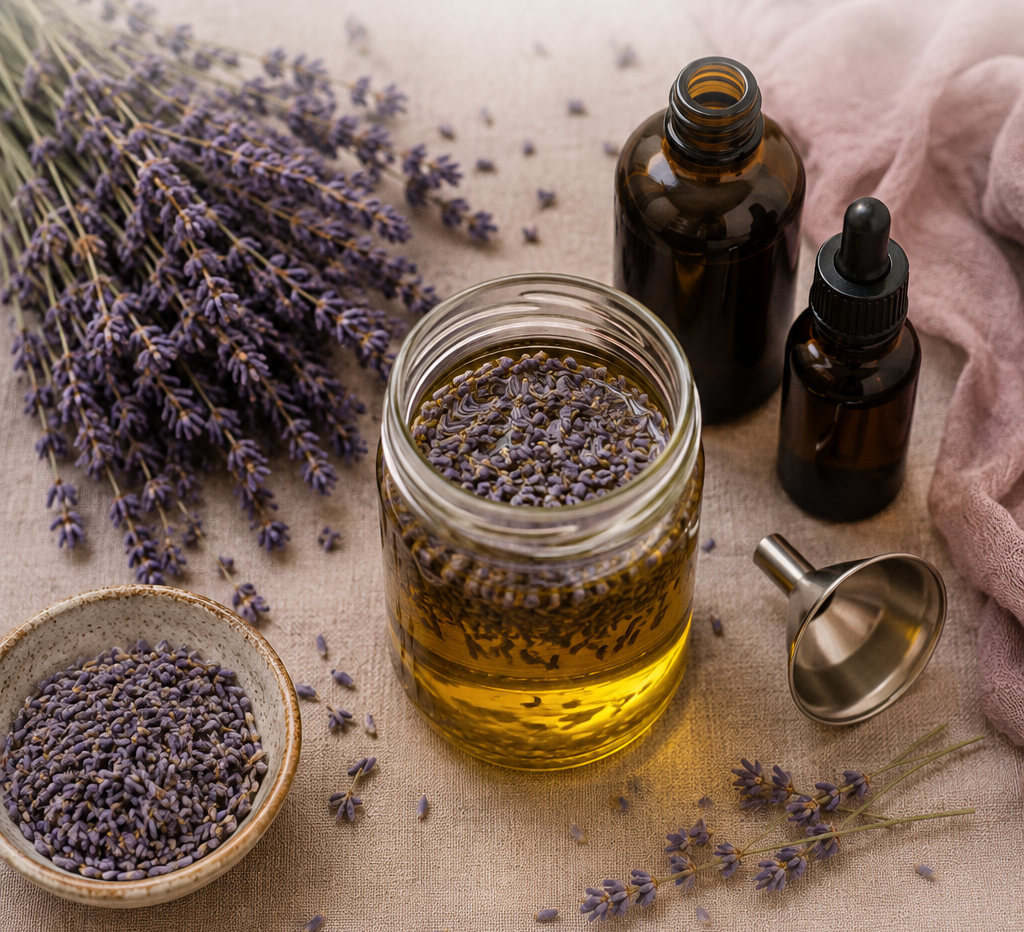
- Dried lavender flowers (dried, not fresh, to reduce the risk of moisture and mould in your jar)
- A carrier oil of your choice: sweet almond, olive, or jojoba are all good options for lavender
- A clean glass jar with a tight-fitting lid
- Cheesecloth or a fine mesh strainer
- Dark glass bottles for storage
- A funnel
- Labels (genuinely useful, future you will thank present you)
🪻 Step-by-Step: Making Lavender-Infused Oil at Home
1. Dry your lavender fully. Any residual moisture is the single biggest cause of a spoiled batch, so make sure your flowers are completely dry before they go anywhere near oil.
2. Fill your jar loosely with dried lavender. Do not pack it tightly. You want the oil to move freely around the flowers.
3. Cover completely with your chosen carrier oil. Every part of the lavender should be submerged. Anything poking above the oil line is a mould risk.
4. Seal and store somewhere warm and dark. A sunny windowsill is not ideal here, gentle warmth without direct light works better for a slow, even infusion.
5. Shake gently every day or two. This helps redistribute the oil and keeps the flowers from settling and clumping.
6. Infuse for two to four weeks. The exact time depends on how strong you want the finished scent. Longer generally means a more pronounced fragrance, within reason.
7. Strain thoroughly. Pour through cheesecloth or a fine mesh strainer, squeezing gently to extract as much oil as possible. Discard the spent lavender.
8. Bottle in dark glass. Use a funnel to transfer the strained oil into your dark glass bottles. Label with the date and carrier oil used.

🔥 A Note on Home Steam Distillation
If infusing has you curious about true essential oil production, here is the honest version of what that involves. You will need either a purpose-built home still or a carefully set up stovetop distillation rig, a large quantity of fresh lavender, and patience. The yield is genuinely low: it takes a significant volume of plant material to produce a small amount of true oil, and the process requires attention throughout to manage temperature and timing.
This is not a beginner weekend project, and it is not something I would recommend jumping into without further dedicated research into distillation equipment and technique. I mention it here so you understand what “real” essential oil production actually requires, rather than assuming it is a scaled-up version of infusing.
❌ Common Mistakes That Ruin a Batch
Using fresh instead of dried lavender. Fresh flowers carry moisture into the jar, which is the fastest route to mould.
Under-filling the oil. Any lavender exposed to air above the oil line can spoil the whole batch.
Storing in clear glass or direct sunlight. Light degrades the aromatic compounds and shortens shelf life considerably.
Expecting infused oil to perform like true essential oil. They are different products with different strengths, and infused oil will always be milder.
Skipping the label. It is easy to lose track of when a batch was made, which matters when you are judging shelf life.
🗄️ Storage & Shelf Life
Store your finished infused oil in dark glass, somewhere cool and away from direct light. Properly made and stored, a lavender-infused oil typically keeps well for six to twelve months, though this varies depending on the carrier oil you used (some carrier oils have a shorter natural shelf life than others, so the carrier is often the limiting factor rather than the lavender itself).
True steam-distilled essential oil has a notably longer shelf life than infused oil, often several years when stored properly, which is one of the practical trade-offs between the two methods.
If your infused oil ever smells off, sour, or musty, discard it. Trust your nose over the calendar date.

💬 Frequently Asked Questions
Can I use fresh lavender instead of dried? You can, but it significantly raises the risk of mould from residual moisture, so dried is strongly recommended for beginners to this method.
Is infused oil the same strength as essential oil? No. Infused oil is meaningfully milder because the aromatic compounds are far less concentrated than in a true steam-distilled essential oil.
Can I speed up the infusion process? Some crafters use a gentle heat method (a double boiler on low heat for a few hours) instead of the slow steep. It works, but it changes the character of the finished oil slightly and requires close attention to avoid overheating the oil.
Why did my oil turn cloudy or develop mould? This almost always traces back to moisture, either from fresh lavender or from lavender not fully submerged in the oil.
🔗 Related Reading
[INTERNAL LINKS PLACEHOLDER: the Blog Profile references a CSV export of published posts as the internal linking source, which was not available in this run. Suggested link slots: a diffuser recipes post, a carrier oil guide, and a DIY skincare oils roundup, once confirmed to exist on the live site.]