I sometimes use affiliate links in content. This doesn’t cost you anything but I may make a commission payment from anything you buy through these links. As an Amazon Associate I earn from qualifying purchases. All opinions remain my own.
I remember the first time I saw a pretty box of essential oils arrive on someone’s doorstep. Tiny amber bottles, a printed card, a little pouch of something that smelled like a spa. I wanted one immediately.
Then the sensible part of my brain asked the question that matters. Is a monthly essential oil box a clever way to build a collection, or a pretty way to end up with a drawer full of bottles you never finish?
The honest answer is that it depends on you. So instead of ranking specific boxes, I’m going to give you the tools to judge any essential oil subscription box yourself: what usually comes inside, how to work out the real cost, what quality markers to look for, and who genuinely benefits.
Table of Contents
📦 What Is Actually in an Essential Oil Subscription Box?
Most boxes follow a similar pattern, though the details vary a lot from one company to the next.
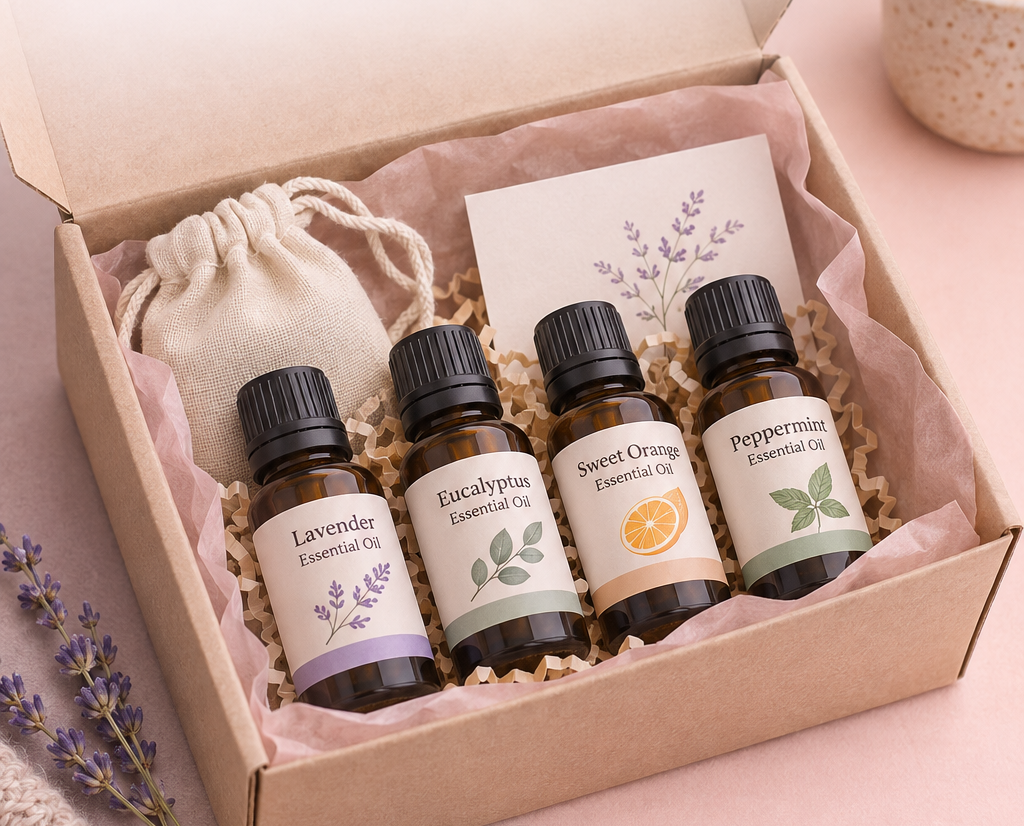
You can usually expect a mix of the following:
- Two to four small bottles of essential oils or ready-made blends
- A carrier oil, or a pre-diluted roller bottle
- An accessory, such as a diffuser pad, a wearable diffuser or a small candle
- An information card with suggested uses
That mix matters, because not everything in the box is an essential oil. Some bottles are blends already mixed with a carrier. Others are fragrance oils, which are synthetic or part-synthetic scents that smell lovely but are a different product altogether.
If you’re new to all this, it helps to know the basics first. My guide to what essential oils are and how you can use them covers the ground in plain language.
🧮 Box Versus Buying Singles: How to Work Out the Real Cost
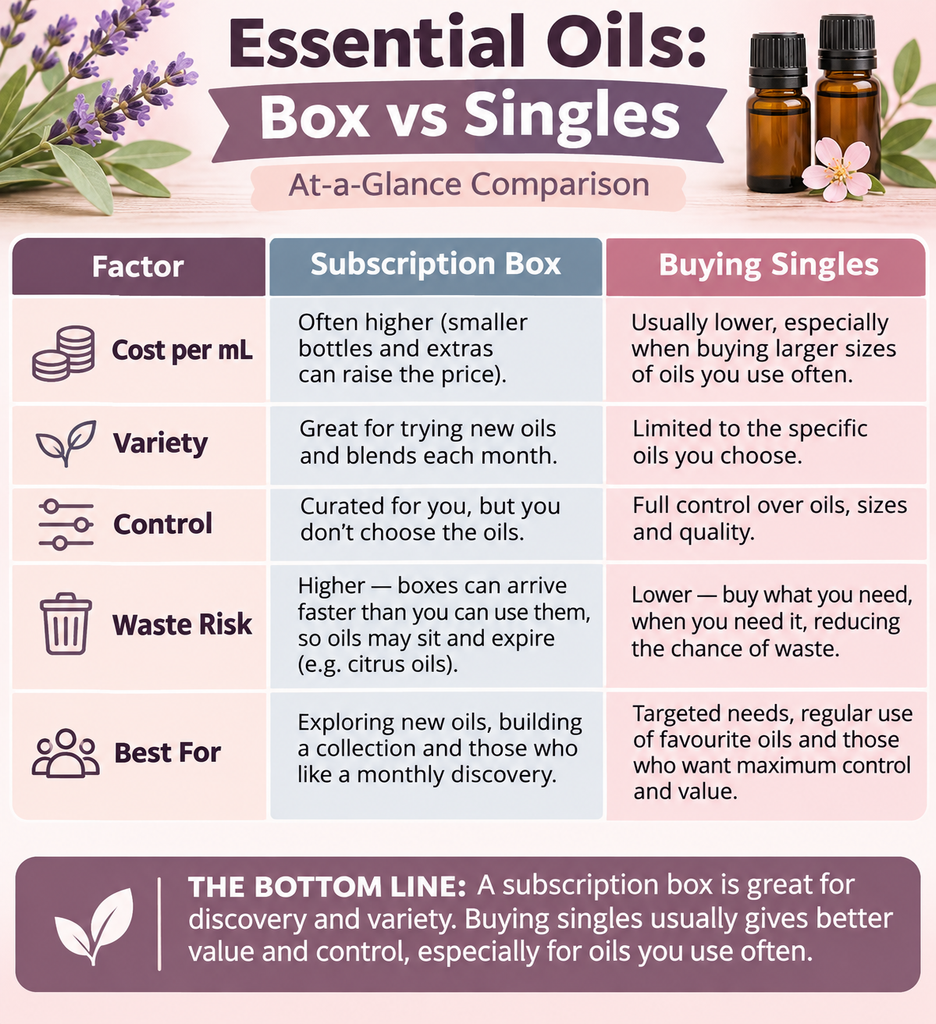
This is where most people get stuck, because a box price and a single-bottle price are not directly comparable. The bottle sizes are different, the oils are different, and the extras muddy the maths.
The fix is to work out the price per millilitre. It takes two minutes.
- Add up the millilitres of true essential oil in the box. Ignore carrier oil, candles and accessories.
- Divide the box price (including postage) by that number.
- Do the same for a single bottle of an oil you’d actually use.
Compare the two numbers, not the totals.
A few things tend to skew the result:
- Small bottles cost more per millilitre than larger ones, so a box of 5 mL bottles starts at a disadvantage.
- Rare oils such as rose, neroli and sandalwood cost far more than lemon or sweet orange, so a box of “premium” oils may be charging for the label.
- Postage and the subscription cadence can quietly add up over a year.
I won’t quote prices here because they change constantly and differ by company. Run the sum with the current figures and the answer will be clear. If the box wins by a wide margin, brilliant. If it only wins because of the free accessory, be honest with yourself about whether you wanted that accessory.
🔬 Quality Checks Before You Subscribe
A pretty box doesn’t tell you much about what’s in the bottle. These checks do.
Botanical (Latin) names. A trustworthy label gives the full botanical name, such as Lavandula angustifolia, rather than just “lavender”. Different species behave differently, and the name tells you which one you have.
Third-party testing. Look for a company that states it uses independent testing, often GC/MS analysis, and will share batch information on request. A vague “100% pure” claim with nothing behind it is a flag.
Country of origin and plant part. Good labels mention where the oil was grown and which part of the plant was used.
Essential oil versus fragrance oil. If the label says “fragrance”, “perfume oil” or “scent oil”, it isn’t an essential oil. Some boxes mix the two, which is fine only if they say so clearly.
Essential oil versus infused oil. This one catches a lot of beginners. An infused oil is a carrier oil with plant material steeped in it. It’s a different product from a distilled essential oil. I explain the difference in my post on homemade rosemary oil, and it’s worth a read before you assume a “rosemary oil” is what you think it is.
If you want a deeper checklist, what to look for when buying essential oils goes through it step by step.
⏳ The Stockpile Problem and Shelf Life
Here’s the part subscription companies rarely mention. Essential oils don’t last forever, and a box that arrives every month can outpace your ability to use it.
As a general guide, citrus oils such as lemon, sweet orange and grapefruit are the first to go off. They oxidise faster, and many people treat them as good for roughly a year or two once opened. Woods and resins, such as sandalwood, cedarwood and frankincense, tend to hold up considerably longer.
These are rules of thumb, not guarantees. Storage makes a big difference, so keep bottles tightly closed, in dark glass, away from heat and sunlight. AromaWeb has a useful overview of essential oil shelf life if you want the detail.
My own post on the shelf life of essential oils also covers how to tell when an oil has turned.
So ask yourself an honest question. How many bottles do you actually get through in a month?
If the answer is one or two, a monthly box of three or four will pile up fast. A bi-monthly or quarterly box, or one you can pause, suits a slower pace much better.
🌱 Who Benefits From a Subscription Box?
A box makes the most sense in a few situations.
You’re a complete beginner. Trying lots of different scents cheaply is the real appeal. You find out whether you love eucalyptus or find it harsh before spending on a full bottle. Pair it with my essential oil basics for beginners guide and you’ll learn quickly.
You enjoy discovery. If opening a surprise parcel is half the fun, a box delivers that. Treat it as a hobby treat rather than a bargain.
You want a gift. A box is an easy, attractive present for someone curious about aromatherapy.
You’re building a starter kit. A few varied oils can help you work out which ones you reach for again and again.
🙅 Who Probably Doesn’t
A box is a weaker fit if any of these sound like you.
You already have a settled routine. If you use the same lavender, lemon and peppermint every week, buying those as singles is almost always cheaper and gives you more control.
You have specific needs. Someone who is pregnant, nursing, living with asthma, or sharing a home with pets or small children needs to choose oils deliberately. Surprise oils aren’t ideal. My post on essential oils for pets shows why this matters.
You like to know exactly what you’re getting. A mystery element can be charming or frustrating, depending on your temperament.
You’re on a tight budget. One good single oil, used well, often gives you more value than four oils you’ll half-use.
If you do want to start with a single bottle rather than a box, a lavender essential oil is the classic first choice. It’s gentle in scent, versatile, and easy to find labelled with its botanical name.
✅ The “Is It Worth It?” Checklist
Run any box through these questions before you hand over your card details.
- Does every oil list its botanical name?
- Is there a statement about independent testing?
- Are essential oils, fragrance oils and blends clearly separated?
- Is the price per millilitre competitive with buying singles?
- Can you skip, pause or cancel easily?
- Will you realistically use the oils before they age?
- Are the extras things you’d actually use?
- Do the oils suit your household, including children, pets and any health considerations?
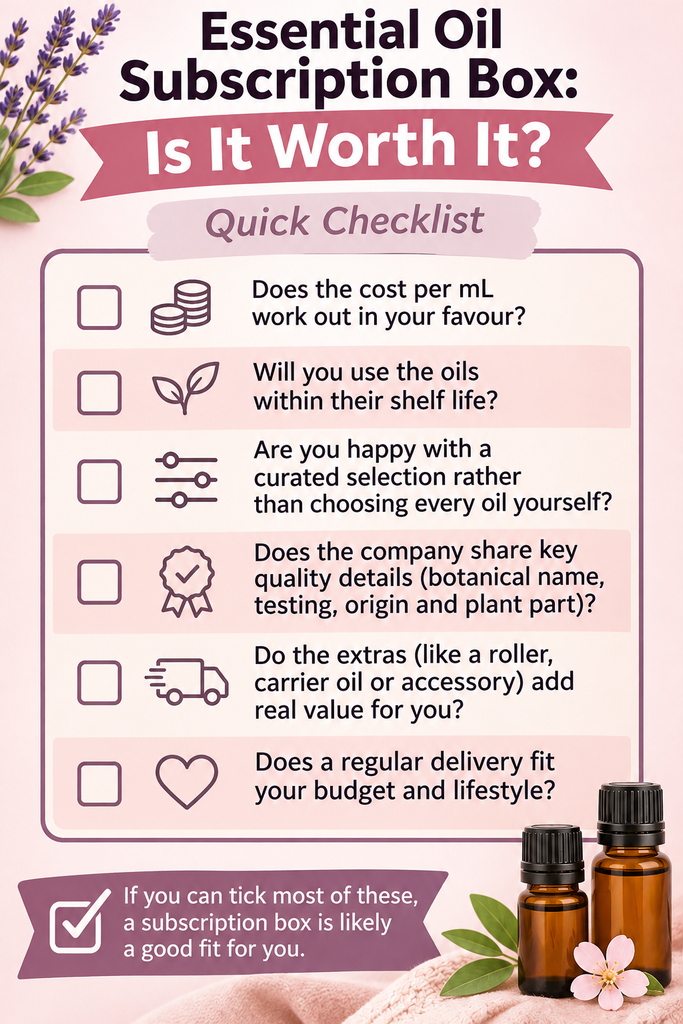
If you can say yes to most of those, the box is likely a reasonable buy. If you’re answering no to several, buy singles instead.
🛡️ A Safety Note for Oils You Didn’t Choose Yourself
This is the part I never skip. When you pick an oil yourself, you’ve (hopefully) read up on it. When a box picks for you, you might not have.
Please follow these basics with every new bottle:
- Never apply undiluted essential oils to your skin. Blend them into a carrier oil first. A common guideline for adults is somewhere around 1 to 2 percent for general use, which works out at roughly 6 to 12 drops of essential oil per 30 mL of carrier. Use lower amounts for children, older adults and sensitive skin.
- Do a patch test. Apply a small diluted amount to your inner forearm and wait 24 hours.
- Don’t swallow essential oils. They are not for ingestion.
- Check before you diffuse around others. Pets, babies and anyone with respiratory conditions can react to oils that are fine for you.
- Research each oil. Some, such as citrus oils, can make skin more sensitive to sunlight. Others aren’t suited to pregnancy.
For skin use, a simple jojoba carrier oil is a stable, gentle base. My post on carrier oils and how they work explains the options, and how to apply essential oils walks through safe methods.
If you’d like to try a few oils on the go without risking spills in your bag, amber glass roller bottles make it easy to pre-dilute a blend and label it clearly.
I always suggest consulting a qualified healthcare professional if you have a medical condition, take medication, or are pregnant or breastfeeding. This post is general information, not medical advice.
🎯 Getting More Out of Your Box
If you do decide to subscribe, a few habits stop the bottles gathering dust.
Label and date everything the day it arrives. It takes seconds and tells you what to use first.
Use the citrus oils first. They have the shortest window, so make them your priority.
Blend with a plan. Once you have three or four oils, mix them. My guide on how to mix essential oils to create your own blends is a gentle place to begin.
Match oils to a diffuser you enjoy. If you don’t own one yet, choosing the right diffuser for your space will save you from a poor purchase. Prefer something portable? Have a look at wearable essential oil diffusers.
Keep a tiny notebook. Jot down what you liked and what you didn’t. After three months you’ll know exactly which singles to buy once you cancel.
💬 The Verdict
An essential oil subscription box isn’t a trick, and it isn’t a bargain by default. It’s a tool.
For a beginner who wants to explore scents, a flexible box can be a fun and sensible start. For someone with a settled routine, buying singles is usually cheaper and gives you far better control.
Do the per-millilitre sum, check the labels, be realistic about how fast you use oils, and keep safety front of mind. Do that, and you’ll make the right call for your own shelf.
If you’re still deciding where to begin, start with the beginners’ guide linked above and pick a single oil you love. You can always add a box later.