
I sometimes use affiliate links in content. This doesn’t cost you anything but I may make a commission payment from anything you buy through these links. As an Amazon Associate I earn from qualifying purchases. All opinions remain my own.
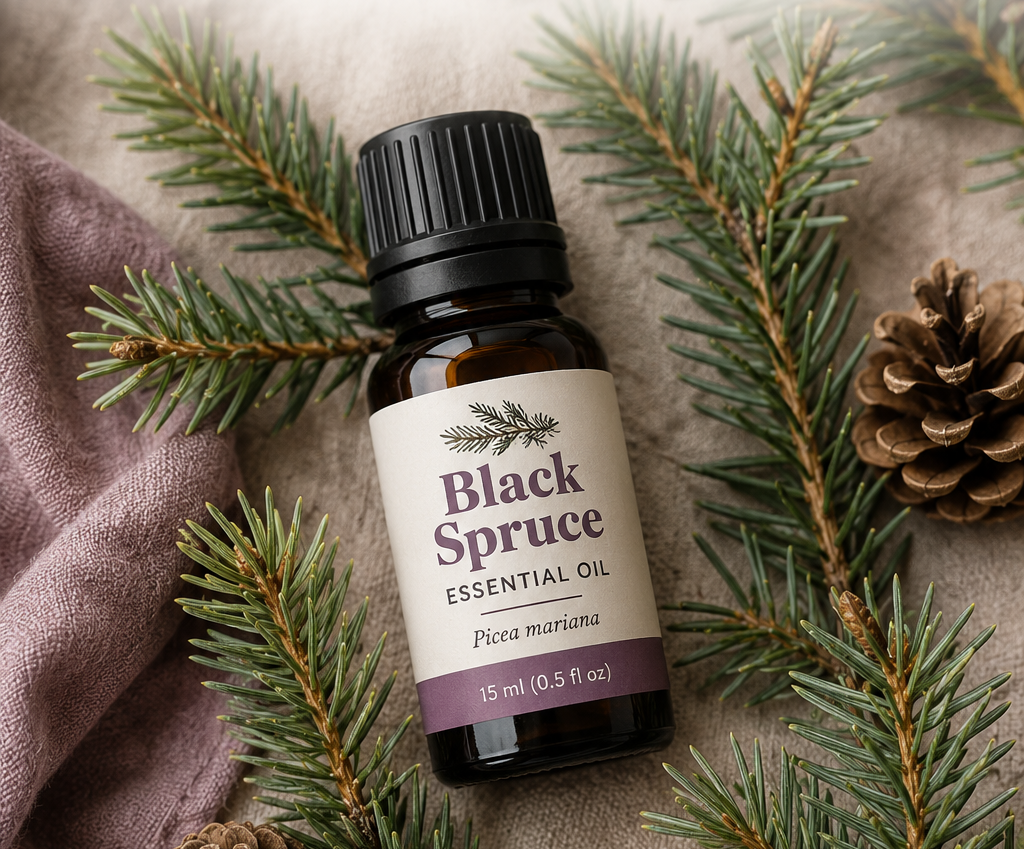
There’s something about the smell of a spruce forest after rain that no candle has ever quite managed to fake. Black spruce essential oil is the closest I’ve found to bottling that feeling, and it’s a scent I think deserves more space on the shelf next to old favourites like cedarwood atlas and frankincense.
If you’ve never worked with a true conifer oil before, here’s everything worth knowing before you buy a bottle: what it actually is, how to use it safely, and how it fits into a seasonal blending routine.
Table of Contents
🌲 What Is Black Spruce Essential Oil?
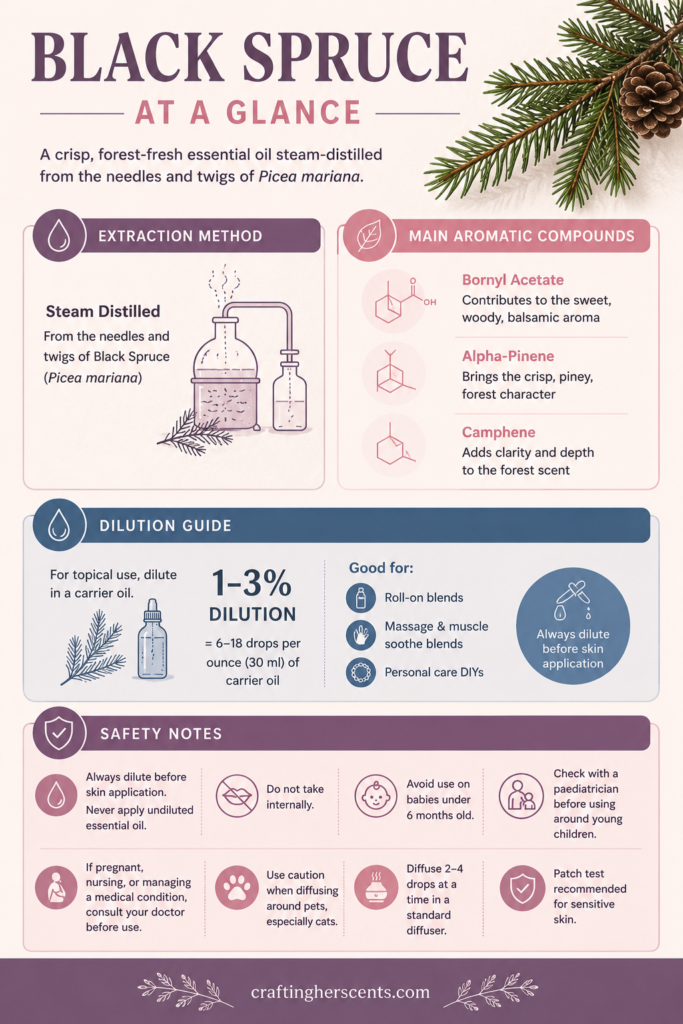
Black spruce essential oil is steam-distilled from the needles and twigs of Picea mariana, an evergreen that grows across Canada and the northern United States. The distillation process pulls out a concentrated, fresh, woody-earthy oil with a sweet, almost balsamic edge underneath.
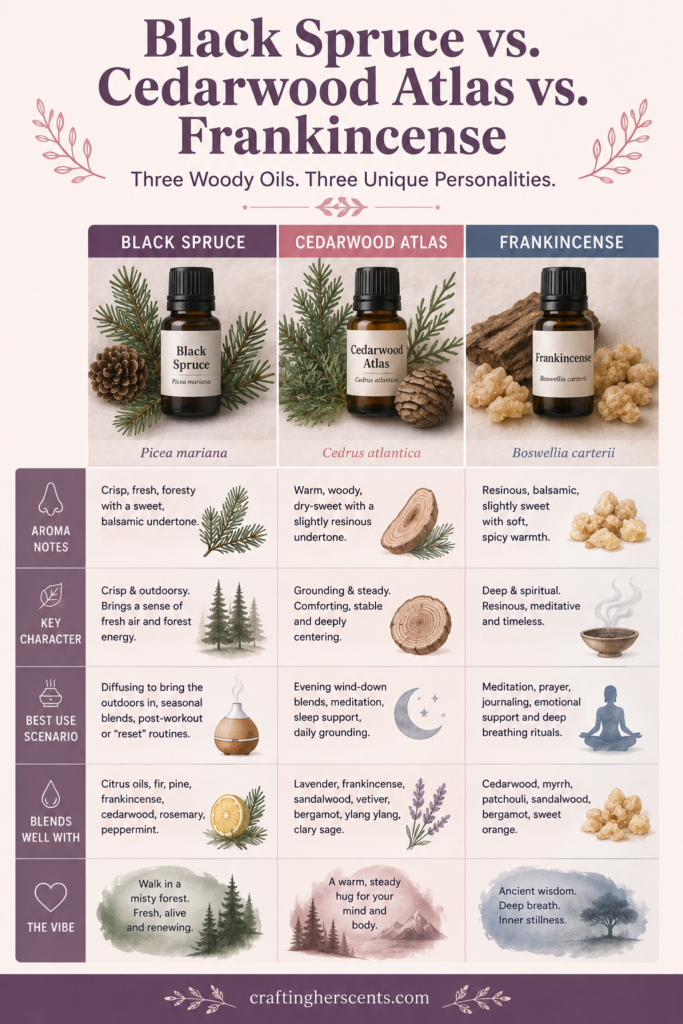
The main aromatic compounds are bornyl acetate, alpha-pinene, and camphene, which is part of why black spruce smells so distinctly “forest” rather than just generically piney. It’s a different chemical family from citrus or floral oils, which is one reason it needs a bit more care with dilution (more on that below).
🌿 How It Compares to Other Woody Oils
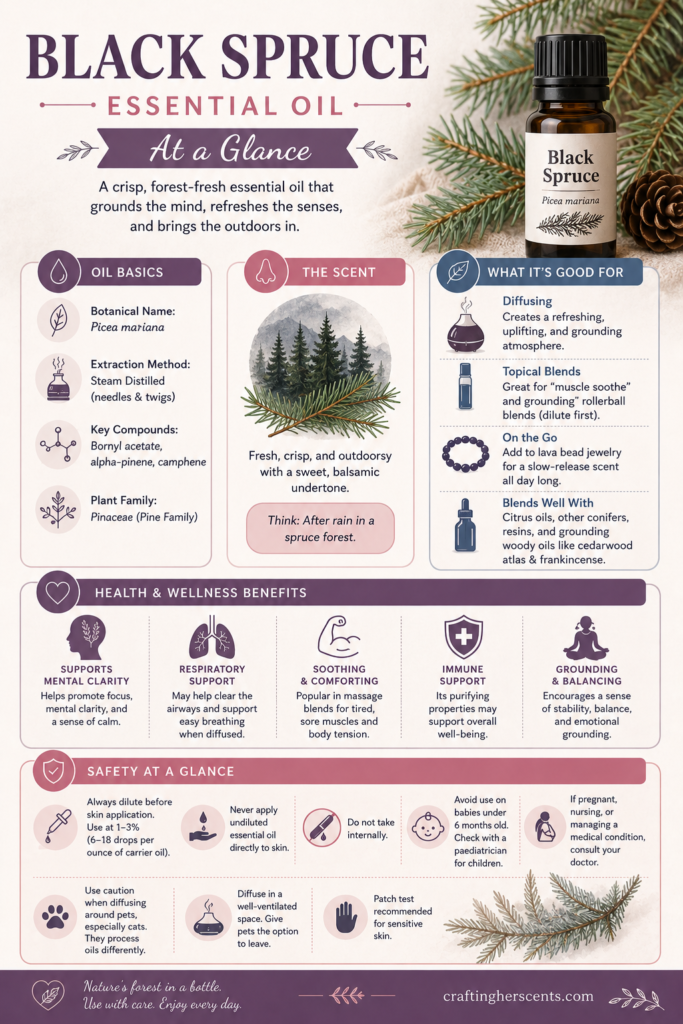
If you already keep cedarwood atlas or frankincense on hand, black spruce is a natural next addition rather than a replacement. Cedarwood atlas leans warm, dry, and slightly sweet. Frankincense is resinous and balsamic with almost no “green” note at all. Black spruce sits between the two but adds something neither has: a crisp, outdoorsy freshness that reads more like standing in an actual forest than a woodshop or an incense shelf.
That makes it a good bridge oil if you love the grounding quality of cedarwood and frankincense but want something that feels a little more alive and seasonal.
🕯️ Ways to Use Black Spruce Essential Oil
In a diffuser. This is the easiest and lowest-risk way to enjoy black spruce. Two to four drops in a standard ultrasonic diffuser is plenty. It pairs beautifully with citrus oils for a brighter, less heavy blend, or with other resins for something deeper and more grounding.
As a diluted topical roll-on. Black spruce is popular in DIY “muscle soothe” and “grounding” rollerball blends, always properly diluted in a carrier oil first. Amber glass roller bottles are worth keeping on hand if you like building your own blends this way, since they protect the oil from light and are easy to label by scent.
On the go. A drop or two on a lava bead bracelet gives you a slow-release scent throughout the day without needing a diffuser nearby. It’s a nice option if you want the forest smell in your bag or on your desk without any liquid to worry about. A lava bead diffuser bracelet is a simple way to try this format.
⚠️ Safety, Dilution, and Who Should Be Cautious
Black spruce is generally well tolerated, but it’s still a concentrated plant extract and should be treated with the same respect as any essential oil.
A few guidelines worth following:
- Always dilute before skin application. A 1–3% dilution (roughly 6–18 drops per ounce of carrier oil) is a reasonable starting point for adults. Our guide to carrier oils walks through how to choose one and get the ratio right.
- Never apply undiluted essential oil directly to skin.
- Don’t take any essential oil internally.
- Avoid use on babies under six months old, and check with a paediatrician before using around young children.
- If you’re pregnant, nursing, or managing a medical condition, talk to your doctor before adding a new essential oil into your routine.
- Diffusing around pets needs its own care, since cats in particular process essential oil compounds differently than we do. Our pet safety guide covers what’s worth knowing before you diffuse around animals in the house.
None of this is meant to be alarming. It’s the same commonsense approach you’d apply to any plant-based extract, just applied consistently.
🧴 Essential Oil vs. Infused Oil: Why the Difference Matters
It’s worth pausing on this distinction, because the two get mixed up more often than you’d think. A true essential oil, like the black spruce oil this post is about, is produced through steam distillation and is a concentrated, chemically distinct extract of the plant’s aromatic compounds. An infused oil is made by steeping plant material in a carrier oil over time, which produces a much more diluted, gentler product that behaves differently on skin and doesn’t carry the same concentration guidance.
We ran into this exact mix-up while covering homemade rosemary oil, where infused and true essential oil versions get conflated online constantly. The short version: if a recipe calls for “essential oil,” don’t substitute a homemade infused oil without adjusting quantities, and don’t assume the two behave the same way.
✨ Blending Pairings for Fall and Winter
Black spruce is a natural fit for cooler months. A few pairings worth trying:
- Citrus lift: black spruce with sweet orange or grapefruit for a brighter, less heavy forest scent.
- Deep and grounding: black spruce with frankincense or cedarwood atlas for a resinous, meditative blend.
- Cosy and spiced: black spruce with a touch of clove or cinnamon bark for a winter-evening feel.
If you’re already building out a seasonal rotation, our Christmas essential oil blends roundup has more combination ideas that black spruce slots into easily.
A Forest Note Worth Adding to Your Collection
Black spruce isn’t a trendy oil, and it doesn’t need to be. It’s the kind of scent that quietly earns a permanent spot in a diffuser rotation once you’ve tried it, especially if you already lean toward woody, grounding blends. Start diluted, start slow, and see how it works into your own routine.


