I sometimes use affiliate links in content. This doesn’t cost you anything but I may make a commission payment from anything you buy through these links. As an Amazon Associate I earn from qualifying purchases. All opinions remain my own.
Here is a fun fact that surprises a lot of people: there is no pumpkin in pumpkin spice. The famous autumn scent is really a blend of warm baking spices, and pumpkin pie just happens to be where we first met it.
That is good news for us, because pumpkin has no essential oil to buy. Instead, we can build the cosy smell from real spice oils, and I will show you exactly how in a bottle-ready 100 ml recipe. I will also be plain about what is in it, what is not, and the safety limits that matter with strong spice oils.
Table of Contents
🎃 What Pumpkin Spice Actually Is
Pumpkin spice is a spice mix, usually cinnamon, ginger, nutmeg and clove. Allspice sometimes joins in too. The smell we link with pumpkin pie comes from those spices, not from the squash.
Because pumpkin itself has no essential oil, any “pumpkin” oil you see for sale is either a fragrance oil or a spice blend with a clever name. That brings me to a distinction worth getting straight before we start.
🧴 Essential Oil, Fragrance Oil or Infused Oil?
These three get muddled all the time, and the difference changes how you use them.
- Essential oil: a concentrated plant extract, usually steam distilled or cold pressed. Cinnamon leaf, clove bud, ginger and nutmeg oils are all true essential oils.
- Fragrance oil: a lab-made scent, which may or may not contain natural ingredients. It is not an essential oil, even when the label sounds natural.
- Infused oil: a carrier oil, such as olive or sunflower, that has had herbs or spices soaked in it. It smells faint and is not the same as an essential oil.
This recipe uses true essential oils only. If you swap in a fragrance oil, the safety notes below no longer apply, so please do not mix the two up.
🍂 The Spice Oils We Will Use
Here is what each oil brings to the blend, and why I chose it. Each one is strong, so the drop counts below are small on purpose.
- Cinnamon leaf: the backbone of the scent. It smells warm and sweet, a bit like cinnamon sticks.
- Clove bud: adds that spicy, almost festive bite. A little goes a very long way.
- Ginger: gives a warm, slightly peppery lift that stops the blend smelling flat.
- Nutmeg: rounds things out with a soft, sweet depth.
- Sweet orange (optional): brightens the blend. It is the one non-spice oil, added as a gentle top note.
If you would like to know more about any of them, I have profiles of clove essential oil, ginger essential oil, cinnamon essential oil and orange essential oil.
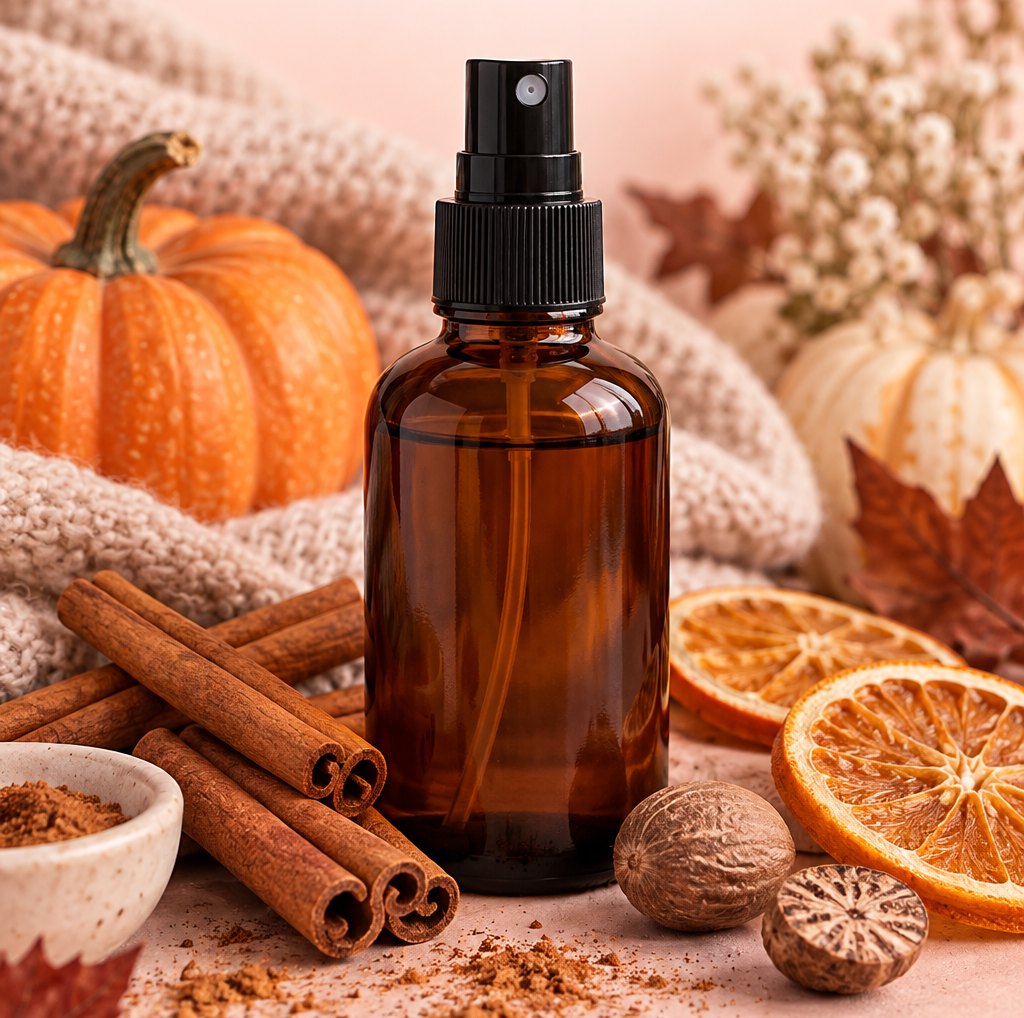
🧪 The Recipe: 100 ml Pumpkin Spice Room Spray
This makes one 100 ml bottle. Use dark glass, ideally amber or cobalt, because light breaks down essential oils faster.
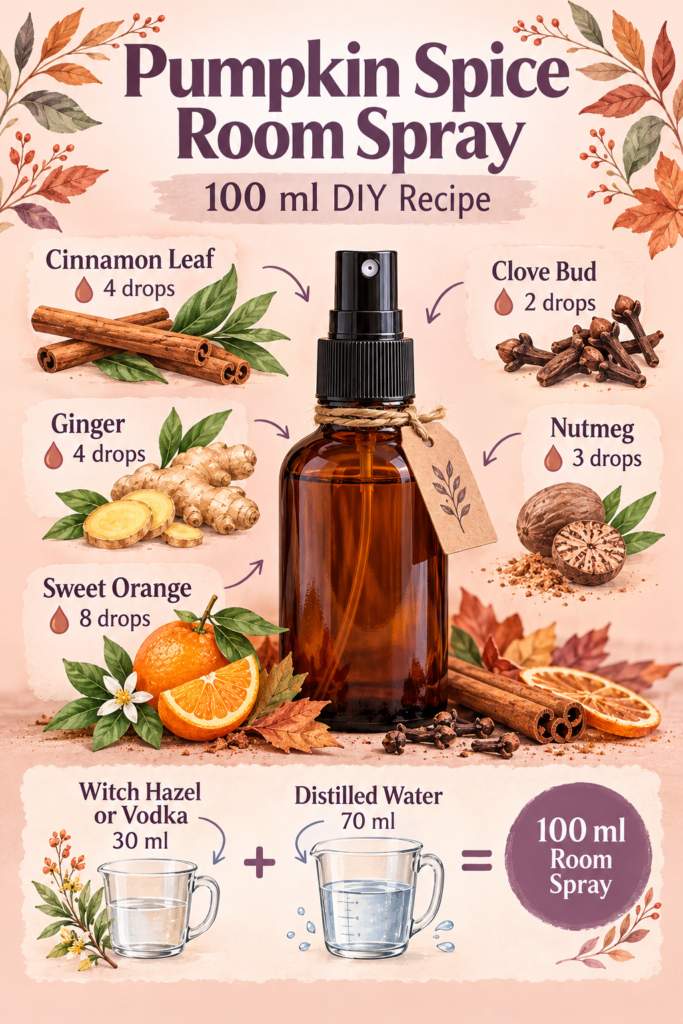
What you need:
- 100 ml dark glass spray bottle
- 30 ml witch hazel or vodka (the base that helps the oils disperse)
- 70 ml distilled water
- 4 drops cinnamon leaf essential oil
- 2 drops clove bud essential oil
- 4 drops ginger essential oil
- 3 drops nutmeg essential oil
- 8 drops sweet orange essential oil
That is 21 drops in total, which works out at roughly 1 ml of essential oil in 100 ml of liquid, or about 1 per cent. Drop sizes vary between bottles, so go by the count rather than guessing by eye.
Method:
- Add the witch hazel or vodka to the bottle first.
- Add the essential oil drops, one oil at a time, and swirl gently.
- Top up with the distilled water, leaving a little space at the top.
- Screw on the spray top, label the bottle and give it a good shake.
Always shake before each spray. Essential oils do not dissolve in water, so they drift to the top between uses. A quick shake keeps the scent even and stops one spritz being stronger than the next.
🌿 Cardamom Twist
For a slightly more perfumed, chai-style version, swap the 3 drops of nutmeg for 3 drops of cardamom essential oil. Cardamom adds a cool, sweet, almost citrusy spice that pairs beautifully with the orange.
I wrote about it in detail in my cardamom essential oil guide, which is worth a read if you have not used it before. Keep every other quantity the same.
🤔 Why a Base Matters
Oil and water do not mix, which is the whole reason this recipe starts with witch hazel or vodka. The alcohol helps the essential oils spread through the water rather than floating in blobs on top.
It is not a perfect solution, and the oils will still separate a little. That is normal, and it is why shaking matters so much. Add the oils to the base first and swirl before topping up with water, which gives them the best chance of dispersing.
If you use witch hazel, be ready to shake the bottle a little more often. Vodka tends to disperse the oils a touch better, so it is my first choice for this blend.
🛠️ Quick Fixes If Something Seems Off
It smells too sharp. Spice oils can smell harsh when freshly mixed. Leave the bottle in a cool, dark place for a day, then smell it again. It usually mellows.
It smells too weak. Resist the urge to add more cinnamon or clove. Try a couple more sprays in a larger room, or add one extra drop of ginger or orange, both gentler than the strong spice oils.
The spray nozzle clogs. Rinse the nozzle in warm water and shake the bottle before spraying. Fine mist nozzles are a little fussy with essential oils, so a good-quality one helps.
⚠️ Safety: Please Read This Part
Strong spice oils need more care than gentle florals. Cinnamon and clove in particular are potent, so the low dilution in this recipe is deliberate.
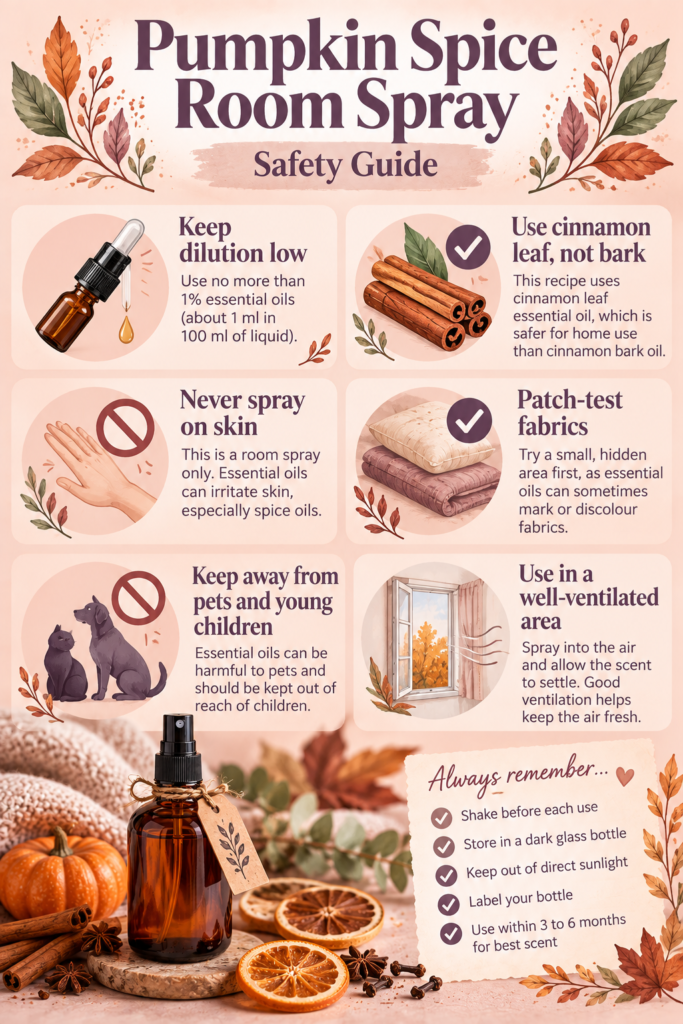
- Keep dilution low. Do not add extra drops hoping for a stronger smell. If you want more scent, spray a little more often instead.
- Choose cinnamon leaf over cinnamon bark. Bark oil is the stronger, harsher option, and I would steer away from it in a room spray.
- This is not for skin. Do not spray it on yourself, and do not apply it undiluted anywhere on the body.
- Patch-test fabrics first. Essential oils can mark or stain, so spritz a hidden corner and let it dry before you spray a sofa or curtains.
- Keep it away from pets and young children. Store it out of reach, and avoid spraying where animals or little ones sleep or play. If you share your home with animals, my post on essential oils for pets goes into this in more detail.
- Ventilate the room. Spray a couple of times, step away, and open a window now and then.
I am cautious rather than alarmed about all of this. A few sensible habits make a spice-oil spray perfectly enjoyable to have around.
📦 Storage and Shelf Life
Store the bottle in a cool, dark cupboard, away from radiators and sunny windowsills. Heat and light are the main enemies of essential oils.
A homemade spray with a water base has no strong preservative, so I make small batches and aim to use it within a few weeks. If it smells off, looks cloudy or develops anything floating in it, tip it out and start again. For more on how long your oils themselves last, see my guide to the shelf life of essential oils.
If you are still building your collection, my post on what to look for when buying essential oils will help you choose well.
🏡 Where and How to Use It
This spray is for freshening the air and soft furnishings, in the same spirit as a seasonal candle. It supports a cosy autumn atmosphere, nothing more.
Some places it works nicely:
- The entryway: a quick spritz as guests arrive.
- Throw blankets and cushions: hold the bottle at arm’s length and mist lightly, after a patch test.
- Curtains: a light mist from a distance, again after testing.
- The car: one gentle spray on the mats, with the windows open for a minute.
Shake, spray into the air, and let it settle. A little really is plenty.
🔄 Two Easy Variations
Once you have made the base recipe, it is easy to tweak the character of the blend.
Softer vanilla and orange version. Cut the clove to 1 drop and the cinnamon leaf to 3 drops, then raise the sweet orange to 10 drops. If you like a vanilla note, use a vanilla absolute or CO2 extract in a very small amount, and check the supplier’s guidance. Do not use a vanilla fragrance oil in its place unless you are happy to leave the “essential oil only” label behind.
Stronger spice version. Keep the total drop count the same, but swap 3 drops of sweet orange for 1 extra drop each of ginger and nutmeg. Resist adding more cinnamon or clove, as those are the oils to be most careful with.
If you are after a different seasonal blend, take a look at my fall essential oils guide. And if you prefer a stovetop approach, my autumn potpourri recipes have simmer pot blends that need no spray bottle at all.
💭 Final Thoughts
Pumpkin spice does not need pumpkin, just a handful of warm spice oils, a dark bottle and a light touch. Keep the dilution low, shake before you spray, and enjoy the scent of autumn.
Have you made a spice room spray before? Tell me which oil you could not do without in the comments.